
For many patients, the first sign is a sudden episode of sharp pain after a heavy meal, a wave of nausea that seems to come from nowhere, or a dull ache under the right ribs that keeps returning. By the time these symptoms appear, gallstones have often been forming silently for months, or even years, without the person ever knowing they were there.
This is exactly where understanding the symptoms, causes, and modern surgical solutions for gallbladder disease becomes essential.
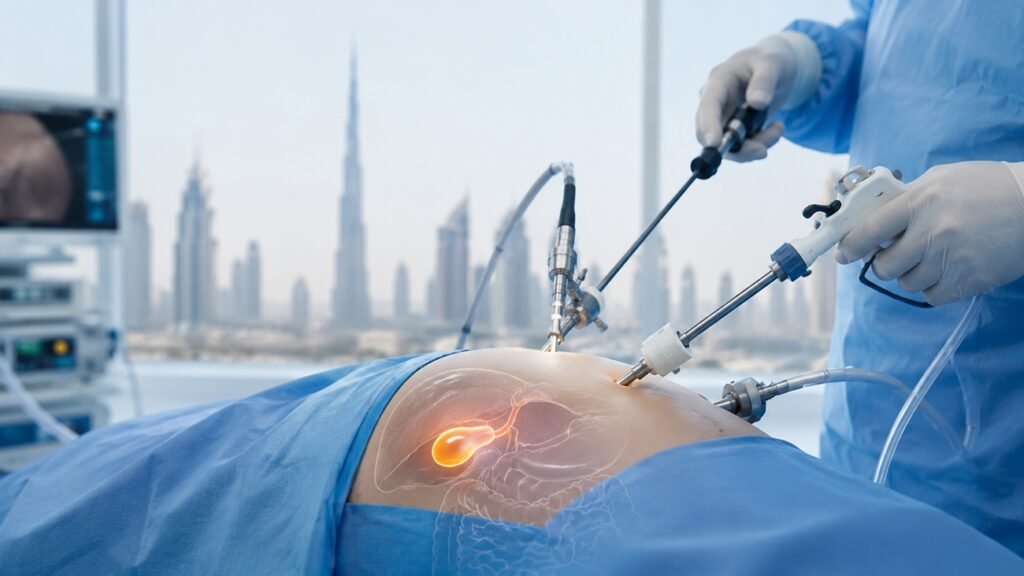
Laparoscopic cholecystectomy — the medical term for keyhole removal of the gallbladder — is now considered the gold-standard treatment for symptomatic gallstones and related gallbladder disease. Under the care of Dr. Ehsan Sotoudeh, the procedure is approached with a strong emphasis on precision, minimal tissue trauma, and a fast, comfortable recovery for every patient.
It is entirely possible to carry gallstones for years without a single symptom. Many people discover them by accident, during an ultrasound performed for an unrelated reason. But once a stone begins to move or partially block the flow of bile, the body usually sends unmistakable signals.
The most frequently reported symptoms of gallstone disease include:
Beyond the classic pattern above, gallstone disease can also present with:
A Key Clinical Insight: These symptoms usually mean that a stone has become lodged in the bile duct, triggering a painful spasm of the surrounding muscle. This is the body’s way of trying to force the obstruction through, and it is precisely why the pain can feel so sudden and severe.
Warning Sign: In more advanced cases, gallstones can lead to serious complications, including:
None of these complications develop overnight. They are almost always the end result of a gallstone problem that went unaddressed for too long.
One of the most overlooked issues in gallbladder disease is how frequently it is mistaken for a stomach problem. Gallbladder pain and stomach pain can feel remarkably similar, both centred in the upper abdomen, both worsened by eating, and both associated with bloating or discomfort.
As a result, it is common for patients to spend years treating what they believe is chronic gastritis or acid reflux, using antacids, dietary changes, and stomach medications, while the underlying cause, a gallbladder full of stones, remains completely unaddressed. The pain returns again and again simply because the real source was never identified.
This is one of the strongest arguments for proper imaging whenever upper abdominal pain becomes a recurring pattern rather than a one-off event.
When it comes to detecting gallstones, not all imaging is equal.
Ultrasound is the most accurate and reliable method for diagnosing gallstones. A CT scan, despite being a powerful imaging tool for many other conditions, frequently fails to detect gallstones. Many stones simply do not show up clearly on CT imaging, particularly smaller or less calcified stones.
This creates an important practical point: if a patient undergoes both a CT scan and an ultrasound, and the ultrasound identifies gallstones while the CT scan appears normal, the ultrasound result should be trusted. Relying on a “clear” CT scan alone in this situation can lead to a missed diagnosis and a continuation of unexplained pain.
For anyone experiencing recurring upper right abdominal discomfort, an abdominal ultrasound should always be part of the initial workup.
Gallstones develop when the normal chemical balance of bile is disrupted. Bile is a digestive fluid produced by the liver and stored in the gallbladder, and it contains a mix of substances, including cholesterol and bilirubin, that must remain properly dissolved. When this balance is upset, these substances begin to crystallise and slowly build up into solid stones.
Bilirubin is a yellow pigment produced when old red blood cells break down in the body. Normally, the liver filters this pigment out of the blood and releases it into the bile so it can be carried to the intestine and eliminated. If something disrupts this pathway, whether in the liver, the bile ducts, or the gallbladder itself, bilirubin can build up in the bloodstream, which is what causes the yellow discolouration of jaundice.
The most frequent cause of gallstone formation is excess cholesterol in the bile. When bile is unable to fully dissolve the cholesterol it contains, the surplus settles out and gradually hardens into stones. These cholesterol stones are typically pale or yellowish in colour and account for the majority of gallstone cases worldwide.
The second major cause is an excess of bilirubin. When more bilirubin is present than the bile can properly process, it can precipitate out and form pigment stones, which tend to be darker in colour.
A Regional Note: Among many patients of Iranian background, gallstones are frequently a mixed type, combining both cholesterol and pigment components, which is why a large proportion of stones seen in this population tend to have a darker, pigmented appearance rather than the paler cholesterol-only variety.
Clinicians commonly refer to a simple memory aid known as the “4F Rule” to describe the classic risk profile for gallstone disease:
Beyond the 4F rule, several other factors are strongly linked to gallstone formation:
Understanding these risk factors allows individuals to recognise when symptoms should be taken seriously, and when a proactive ultrasound screening might be worthwhile even in the absence of symptoms.
This is one of the most misunderstood aspects of gallstone disease.
Gallstones can remain completely silent for a long time, in some cases up to a decade, without producing any noticeable symptoms. However, silence does not mean the condition has resolved. Many of these cases still eventually require surgery once symptoms emerge or complications develop. Because gallstones rarely disappear on their own, the safest approach is to confirm their presence through ultrasound and monitor the situation with medical guidance.
Many patients assume that a small gallstone poses less risk than a large one, and choose to leave it untreated. In reality, the opposite is often true. Smaller stones move more freely and are more likely to slip into and become lodged within the narrow bile ducts, where they can trigger pain, inflammation of the gallbladder, or even jaundice. A small stone left untreated can still lead to significant complications; size alone is not a reliable indicator of safety.
Certain situations call for prompt surgical evaluation rather than a “wait and see” approach:
Patients who fall into any of these categories should not delay seeking a surgical opinion.
Yes. The gallbladder is a useful organ, but it is not essential for survival. After it is removed, the liver continues to produce bile just as before, and digestion continues largely as normal.
A widespread misconception is that patients who have their gallbladder removed must avoid fatty foods for the rest of their lives. This is not accurate. In most cases, patients return to their normal activity levels and their usual diet within about a week of surgery. Some people notice mild, temporary digestive adjustments in the early weeks, but a permanent, restrictive diet is not typically required.
In the vast majority of cases, gallbladder removal is performed using the laparoscopic method rather than traditional open surgery.
Instead of one large incision across the abdomen, the laparoscopic approach involves:
This minimally invasive technique offers clear benefits over traditional open surgery:
Open surgery is reserved for specific, more complex situations, such as significant scar tissue from previous surgeries, severe inflammation, or unclear anatomy discovered during the procedure. For the overwhelming majority of patients, the laparoscopic technique is both safer and considerably more comfortable.
The process begins with a detailed evaluation of your symptoms, medical history, and relevant imaging, most importantly an abdominal ultrasound, to confirm the diagnosis and rule out other causes of abdominal pain.
Patients receive clear instructions regarding fasting, medication adjustments, and what to expect on the day of surgery, with any questions addressed in advance.
Performed under general anaesthesia, the surgery usually takes between 30 and 60 minutes. The abdomen is gently inflated with carbon dioxide gas to create working space, and the gallbladder is carefully separated and removed through the small incisions.
Most patients are monitored for a short period after surgery and, in many cases, can return home the same day or the following morning.
A follow-up appointment allows the surgical sites to be checked, questions to be addressed, and a personalised recovery plan confirmed.
The entire pathway is designed to minimise discomfort while ensuring a safe, closely monitored recovery from start to finish.
Gallstones are among the most frequent digestive health issues worldwide.
Because gallstone disease is so widespread, laparoscopic cholecystectomy is one of the most commonly performed abdominal surgeries globally, with an excellent long-term safety record.
Dubai’s fast-paced lifestyle, dietary patterns, and demanding work schedules can contribute to several of the risk factors linked to gallstone formation, including irregular eating habits, high-fat diets, and periods of rapid weight change following intensive diets or bariatric procedures. Many residents and long-term visitors experience gallbladder symptoms for months without realising how common, and how treatable, the condition actually is.
Access to advanced laparoscopic techniques in Dubai means patients no longer need to endure prolonged discomfort or resort to more invasive surgical options. Minimally invasive treatment is readily available locally, backed by modern surgical technology and experienced clinical care.
Yes. Laparoscopic cholecystectomy is considered a well-established, low-risk procedure when performed by an experienced surgical team. As with any operation, some risks exist, including infection, bleeding, or, rarely, injury to nearby structures such as the bile duct. However, these risks are significantly lower with the laparoscopic technique compared with open surgery, and serious complications remain uncommon.
A detailed pre-operative assessment helps identify any individual factors that may influence the safest surgical approach for each patient.
For patients living with recurring gallbladder pain, the real choice is rarely between surgery and no surgery. It is between continuing to manage painful, unpredictable episodes, or resolving the problem definitively through a safe, minimally invasive procedure.
Laparoscopic gallbladder surgery offers:
Rather than waiting for symptoms to escalate into an emergency, timely evaluation allows the condition to be treated calmly, safely, and on the patient’s own schedule.
Dr. Ehsan Sotoudeh approaches gallbladder surgery with a focus on:
Patients who value precision, safety, and attentive care throughout the surgical journey often choose this approach for the treatment of gallstone disease and related gallbladder conditions.
Gallbladder pain is often dismissed as ordinary indigestion until symptoms become impossible to ignore. Recognising the early warning signs, understanding the true risk factors, and seeking timely, accurate diagnosis through ultrasound can prevent complications and lead to a swift, effective resolution.
Laparoscopic gallbladder surgery, performed with modern minimally invasive technique, offers a safe and proven path back to comfortable, symptom-free living.
Laparoscopic gallbladder surgery is performed by Dr. Ehsan Sotoudeh at Eden Aesthetics Clinic. All procedures are carried out using advanced minimally invasive surgical technology in a professional medical setting, with a strong emphasis on patient safety, comfort, and evidence-based surgical care.
The goal is always the same: resolve the underlying condition with the least possible disruption to the patient’s body and daily life.
If you experience recurring pain in the right side of your abdomen after eating, or if you have already been diagnosed with gallstones, a consultation can clarify your options and outline the safest path forward.
Timely treatment prevents complications, and it begins with a clear, informed conversation about your symptoms and health.