
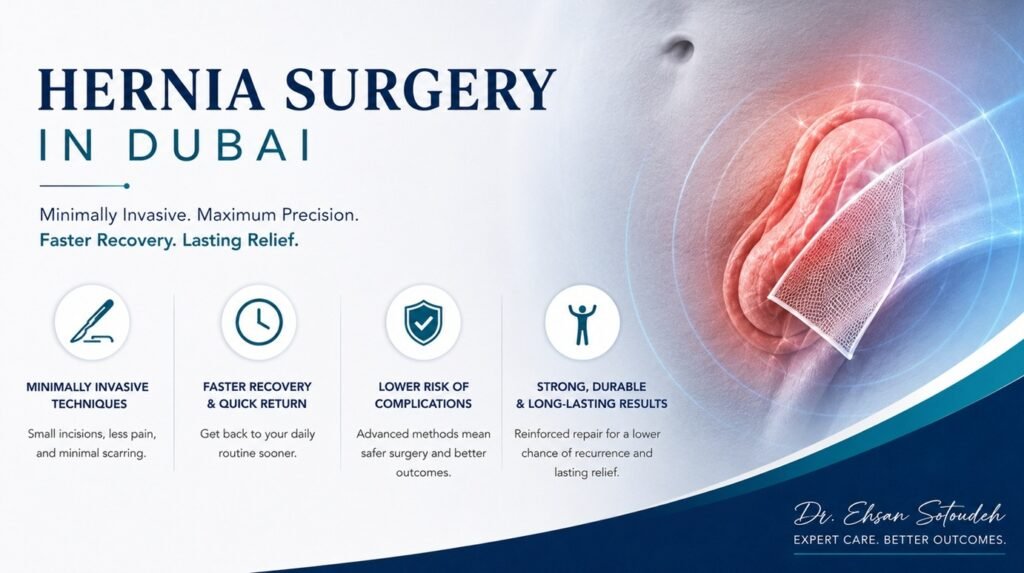
What often begins as a small, painless bulge, easy to dismiss as nothing serious, can slowly grow larger over time, becoming more uncomfortable, more visible, and eventually more difficult to treat. Many patients live with a hernia for months or even years before seeking help, not realising that early treatment is almost always simpler, safer, and more effective than waiting.
This is where a clear understanding of hernia surgery becomes essential.
Hernia repair is one of the most commonly performed surgical procedures worldwide, and modern techniques have transformed it into a fast, minimally invasive, and highly reliable solution. Under the care of Dr. Ehsan Sotoudeh, hernia surgery is approached with a strong focus on precision, minimal tissue disruption, and a smooth return to normal life.
A hernia occurs when an internal part of the body, most often a portion of fatty tissue or intestine, pushes through a weak spot in the surrounding muscle or connective tissue that would normally hold it in place. This creates a visible or palpable bulge, which may become more noticeable when standing, coughing, or straining, and may partially disappear when lying down.
Hernias do not heal or resolve on their own. Because the underlying muscle weakness does not repair itself naturally, the opening tends to widen gradually over time, allowing more tissue to protrude and increasing the risk of complications.
Hernias are classified according to where they occur in the body. The most frequently diagnosed types include:
Each type has distinct characteristics, but all share the same underlying issue: a structural weakness that allows tissue to push through where it shouldn’t.
Hernias do not always cause dramatic symptoms, especially in the early stages. Common signs include:
A Key Clinical Insight: Pain that suddenly becomes severe, constant, and is accompanied by nausea, vomiting, or a bulge that turns red, purple, or dark and cannot be pushed back in, may indicate that the hernia has become incarcerated or strangulated. This is a medical emergency, as it means the trapped tissue’s blood supply may be compromised, and it requires immediate surgical attention.
One of the most persistent misconceptions is that a small, painless hernia can simply be left alone indefinitely. In reality, hernias are progressive. Without surgical repair, the muscle opening tends to widen over time, allowing more tissue to protrude and increasing the likelihood of complications.
The most serious of these complications is strangulation, where the blood supply to the protruding tissue becomes cut off. This is a surgical emergency that can lead to tissue death within hours if not treated promptly. What could have been a straightforward, planned procedure can quickly become a far more complex and urgent operation.
This is why most surgeons recommend repairing a diagnosed hernia electively, on the patient’s own schedule, rather than waiting for symptoms to worsen or for an emergency to develop.
Hernias form when a combination of muscle weakness and increased internal pressure allows tissue to push through the abdominal wall. Several factors can contribute to this process:
Understanding these risk factors helps explain why hernias are so common and why certain individuals, such as those with physically demanding jobs or a history of prior surgery, may be at higher risk.
In many cases, a hernia can be identified through a physical examination alone, as the surgeon can often see or feel the bulge, particularly when the patient is asked to cough or strain. However, imaging is sometimes used to confirm the diagnosis or assess more complex cases, particularly when the hernia is not easily visible or palpable, such as with certain hiatal or early-stage incisional hernias.
Ultrasound is frequently the first imaging tool used, as it is quick, radiation-free, and highly effective at visualising soft tissue movement in real time. In more complex or unclear cases, a CT scan may be used to provide a more detailed view of the abdominal wall and surrounding structures, particularly useful for larger or recurrent hernias.
A thorough diagnostic evaluation ensures that the surgical approach can be planned accurately before the procedure begins.
Historically, hernia repair required a single, often sizeable incision directly over the affected area. While open repair remains an appropriate option in certain cases, laparoscopic, or keyhole, hernia repair has become the preferred technique for many patients due to its considerable advantages.
In laparoscopic hernia repair, the surgeon works through a small number of tiny incisions, typically less than a centimetre each. A thin camera provides a magnified, high-definition view of the abdominal wall from the inside, while specialised instruments are used to reposition the protruding tissue and reinforce the weakened area, most often with a supportive surgical mesh.
Compared with traditional open surgery, laparoscopic hernia repair typically offers:
Open repair may still be recommended in certain situations, such as very large hernias, complex recurrent cases, or when a patient has specific anaesthesia considerations. The right approach is always determined based on the individual patient’s anatomy and medical history.
For most hernia repairs, particularly larger or recurrent ones, surgical mesh is used to reinforce the weakened area of the abdominal wall. The mesh acts as a supportive scaffold, allowing the body’s own tissue to grow into and around it, creating a stronger, more durable repair than stitching the weakened muscle edges together alone.
Modern surgical mesh is designed to be biocompatible and is associated with significantly lower recurrence rates compared with older, non-mesh repair techniques. In smaller hernias, or in specific clinical situations where mesh is not suitable, a tension-based repair using sutures alone may be considered instead, though this is generally reserved for particular cases rather than used as a routine first choice.
The process begins with a detailed evaluation of the hernia’s type, size, and location, along with a review of the patient’s overall health and any relevant imaging, to determine the most appropriate surgical approach.
Patients receive clear guidance on fasting, medication adjustments, and what to expect on the day of the procedure, with time set aside to address any questions or concerns.
Performed under general or, in some cases, local or regional anaesthesia depending on the hernia type and patient factors, the surgery typically takes between 30 and 90 minutes, depending on complexity. The protruding tissue is carefully repositioned, and the weakened area is reinforced, most often with surgical mesh.
Many hernia repairs, particularly laparoscopic ones, are performed as day-case procedures, allowing patients to return home the same day. Larger or more complex repairs may require a short overnight stay for monitoring.
A follow-up appointment allows the surgical sites to be checked, recovery progress reviewed, and any questions about returning to normal activity addressed.
The overall pathway is designed to minimise discomfort while ensuring a safe, closely monitored recovery.
Most patients recover from laparoscopic hernia repair considerably faster than they expect. In the first few days, some soreness, mild swelling, and bruising around the incision sites are normal and generally manageable with simple pain relief.
General recovery guidance typically includes:
Most patients return to desk-based work within a week and to more physically demanding activity within four to six weeks, depending on the complexity of the repair and the nature of their work or exercise routine.
Many patients delay treatment because their hernia isn’t currently painful. However, the absence of pain does not mean the hernia isn’t progressing. Since hernias only grow larger over time and cannot heal on their own, a painless hernia today can become a painful, or even an emergency, one later.
Concerns about mesh safety are common, often based on outdated information or cases involving different mesh types used in different procedures, such as certain gynaecological applications. Modern, appropriately selected hernia mesh has an extensive safety record and significantly reduces the likelihood of the hernia recurring compared with non-mesh repairs.
With modern laparoscopic technique, recovery is often measured in days and weeks rather than months. Many patients underestimate how much less invasive current hernia repair has become compared to the open surgeries of the past.
Hernias are among the most frequently diagnosed surgical conditions worldwide.
Because hernias are so common, and because delayed treatment carries real risks, timely surgical evaluation is one of the most valuable steps a patient can take for their long-term abdominal health.
Dubai’s active lifestyle, from gym culture and competitive sports to physically demanding jobs in construction and logistics, means that heavy lifting and repeated physical strain are common features of daily life for many residents. Combined with dietary and weight-related risk factors, these patterns can contribute to the development of hernias, particularly inguinal and incisional types.
Access to advanced laparoscopic hernia repair in Dubai means patients no longer need to endure prolonged discomfort, restrict their activity indefinitely, or risk waiting until an emergency develops. Minimally invasive treatment is readily available locally, backed by modern surgical technology and experienced clinical care.
Yes. Hernia repair, particularly using the laparoscopic technique, is considered a well-established, low-risk procedure when performed by an experienced surgical team. As with any operation, some risks exist, including infection, bleeding, or, less commonly, hernia recurrence. However, these risks are significantly reduced with modern surgical technique and appropriate mesh reinforcement, and serious complications remain uncommon.
A thorough pre-operative assessment helps identify any individual factors that may influence the safest surgical approach for each patient.
For patients living with a diagnosed hernia, the real choice is rarely between surgery and no surgery. It is between addressing the problem now, calmly and on a planned schedule, or risking a more urgent and complex situation later.
Laparoscopic hernia repair offers:
Rather than waiting for a hernia to become larger, more painful, or an emergency, timely evaluation allows the condition to be treated safely, effectively, and on the patient’s own terms.
Dr. Ehsan Sotoudeh approaches hernia repair with a focus on:
Patients who value precision, safety, and attentive care throughout the surgical journey often choose this approach for the treatment of hernias of all types.
A hernia is not something that resolves with time, rest, or willpower alone. The safest, most comfortable path forward is always the one taken early, before pain increases and options narrow.
If you have noticed a bulge, pressure, or discomfort in your abdomen or groin, or if you have already been diagnosed with a hernia, now is the time to book a consultation. Timely treatment prevents complications, and it begins with a clear, informed conversation about your symptoms, your options, and the safest path back to comfortable, active living.