
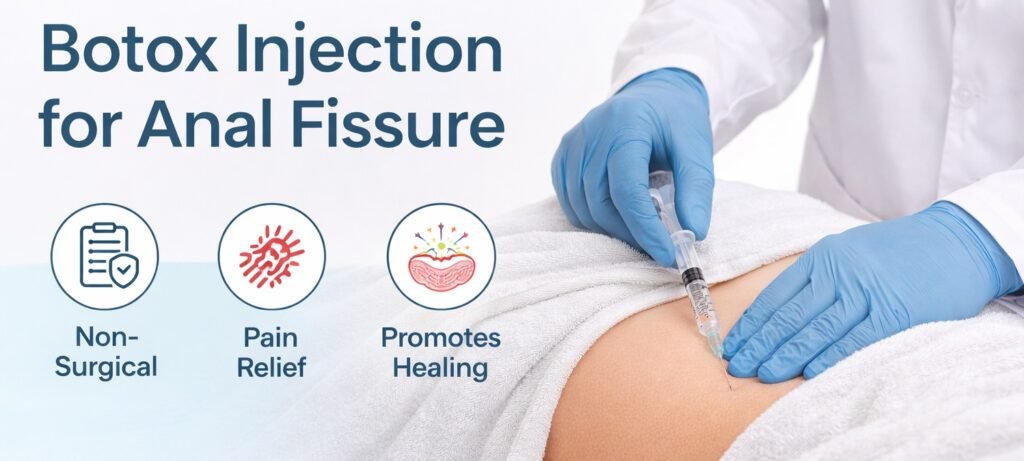
Botox injection for anal fissure is a safe and effective non-surgical treatment designed to relieve pain and promote healing without the need for surgery. This procedure is performed in Dubai by experienced medical professionals and is commonly recommended for patients who have not responded well to creams or medications.
Botox works by temporarily relaxing the anal sphincter muscle, reducing pressure on the fissure and allowing the damaged tissue to heal naturally. For many patients, this treatment provides significant pain relief and long-term improvement with minimal downtime.
Anal fissure is a condition that many people suffer from silently.
It is painful, often embarrassing to talk about, and frequently misunderstood as “just hemorrhoids” or a temporary irritation that will pass on its own. This belief “anal pain will heal by itself”,is one of the most common reasons patients delay proper care. Unfortunately, that delay can allow a simple fissure to evolve into a chronic condition that is far more difficult to treat.
In reality, an anal fissure can become a chronic, recurring problem that significantly affects daily life, bowel habits, emotional well-being, and overall quality of life. Persistent pain may shape daily routines, restrict social activities, and create constant anxiety around bowel movements.
The good news is that modern, non-surgical treatments, including Botox injection and PRP (Platelet-Rich Plasma) therapy, have transformed how anal fissures are managed. These approaches focus on healing the fissure, reducing pain, restoring normal muscle function, and avoiding surgery whenever possible.
Under the care of Dr Ehsan Sotoudeh, anal fissure treatment is approached as a functional medical problem, not something patients should simply tolerate or feel ashamed to discuss. The goal is relief, tissue healing, and long-term resolution, using evidence-based methods tailored to each patient’s condition and lifestyle.
An anal fissure is a small tear or crack in the lining of the anal canal. Although the injury itself may be superficial, the pain it causes can be intense and persistent, often described as sharp, burning, cutting, or tearing during and after bowel movements.
Many patients say it feels as if the skin in that area has “split open” or been “cut with a blade.” The pain may last for minutes or extend for hours after defecation, making everyday life uncomfortable and stressful.
Anal fissures most commonly occur in the posterior (back) part of the anal canal, an area with naturally lower blood supply. Reduced circulation in this region makes healing slower and increases the risk of the fissure becoming chronic.
Anal fissures often involve both physical pain and emotional distress. Common symptoms include:
Over time, many patients develop a predictable cycle:
pain → muscle spasm → reduced blood flow → delayed healing
Without proper treatment, this cycle can persist for months or even years.
In the early (acute) stage, some fissures may heal with conservative measures such as dietary changes, hydration, stool softening, and topical medications. However, a large proportion do not.
Anal fissures become chronic mainly due to:
Once a fissure becomes chronic, spontaneous healing is unlikely. At this stage, targeted medical treatment is usually required.
Leaving an anal fissure untreated or inadequately treated can:
Modern treatment strategies aim to break the pain–spasm–non-healing cycle early, before permanent changes develop.
Today, many patients can avoid surgery thanks to Botox injection and PRP therapy in dubai, used alone or in combination depending on the severity, duration, and cause of the fissure.
These treatments are designed to address the root mechanisms of anal fissure rather than providing temporary symptom relief.
Botox (botulinum toxin) works by temporarily relaxing the internal anal sphincter muscle. In patients with anal fissure, this muscle is often in a state of constant involuntary spasm.
By reducing sphincter pressure:
Crucially, Botox does not permanently weaken the muscle. Its effect is temporary and controlled, allowing healing without compromising bowel control.
Many patients notice pain reduction within days to weeks as muscle tension decreases and healing begins.
Onset of effect: A few days to 1 week
Duration of effect: Approximately 3 to 6 months
If the fissure heals fully during this period, symptoms often do not return, even after the effect of Botox wears off.
✅ In many patients, one injection is enough
🔁 In chronic or resistant cases, a repeat injection may be recommended
For many patients, yes. Botox injection can be a highly effective alternative to surgical treatment for anal fissure, especially in early or moderate cases.
Surgery is usually considered only when conservative and non-surgical treatments fail. Botox allows many patients to avoid surgery while still achieving meaningful relief and healing.
The success of anal fissure Botox treatment does not depend on the injection alone. Long-term results are strongly influenced by:
Managing constipation
Following a fiber-rich diet
Drinking enough fluids
Adhering to medical advice and aftercare instructions
These steps play a key role in preventing recurrence and maintaining results.
If you are looking for a non-surgical treatment for anal fissure in Dubai, Botox injection may be the right option for you.
Our team offers personalized care to help relieve pain, promote healing, and improve your quality of life.