



Regenerative medicine brings together treatments that use the body’s own biological materials, living cells or cell-derived signals to support a defined clinical goal. For someone researching regenerative medicine in Dubai, the difficult part is rarely finding treatment names. It is understanding what each name means, whether the proposed product and route match the evidence, and what a realistic treatment plan looks like.
Platelet-rich plasma, usually shortened to PRP, is prepared from a patient’s own blood. Autologous cell-based procedures use material collected from the same person. Exosomes are tiny particles released by cells; they are not stem cells. Blood-forming stem-cell transplantation is another form of cell therapy, but it belongs in specialist hospital transplant programmes rather than an outpatient regenerative or aesthetic clinic.
Those differences shape the purpose, evidence, preparation, recovery and regulation of each approach. Evidence from one material, condition or route cannot automatically be transferred to another. A good consultation therefore starts with the diagnosis and the outcome the patient hopes to achieve. The treatment name comes later.
At EDEN AESTHETICS Clinic in Business Bay, Dr. Ehsan Sotoudeh assesses regenerative options within a wider medical plan. The aim is to identify whether there is an appropriate pathway, explain what it involves and set useful follow-up points. This guide covers the services currently described by EDEN as well as related treatments that patients often encounter while researching the field.
The short answer: PRP, an eligible autologous adipose-derived stromal vascular fraction (SVF) pathway and exosome-based approaches are not interchangeable. EDEN describes each as assessment-led. Autologous SVF is limited to a narrow, minimally manipulated and homologous-use pathway. EDEN’s detailed exosome policy states that IV administration is not offered for general wellbeing, detox, energy, recovery or anti-ageing enhancement; it is considered only when the treating physician documents a medical indication. No treatment can be confirmed from a webpage or online enquiry alone.
Table of Contents
- What Regenerative Medicine Means
- Regenerative Options and EDEN Services
- What Current Research Shows
- Regenerative Medicine in Dubai
- Who May Be a Suitable Candidate
- Consultation, Treatment and Safety
- Dr. Ehsan’s Treatment Philosophy
- Frequently Asked Questions
What Regenerative Medicine Means
Regenerative medicine is a broad area of healthcare and research concerned with repairing, replacing or supporting cells, tissues and organs affected by injury or disease. It draws on cell biology, bioengineering, biomaterials and the body’s own healing mechanisms. The US National Institute of Dental and Craniofacial Research describes the field as using growth mechanisms and healing properties to repair or replace damaged cells, tissues or organs. [1]
The word “regenerative” does not describe a single product. It may refer to a preparation made from blood, a cell-containing material, a laboratory-developed cell therapy, a tissue-engineered product or a cell-derived signal. Even treatments in the same category can differ substantially. Two PRP preparations may have different platelet and white-cell concentrations. Cell-based preparations may come from bone marrow, adipose tissue or another source and may be processed differently. Exosome products vary according to their source, isolation method, purity, dose and route of administration.
This is why the most useful questions are specific:
- What is the material and where does it come from?
- How is it collected, prepared and administered?
- What condition or concern is the treatment intended to address?
- What outcomes have been studied with a comparable protocol?
- How will the patient’s response be measured?
The body already coordinates repair through platelets, immune cells, growth factors and cell-to-cell communication. Regenerative approaches try to use selected parts of that biology for a defined purpose. Depending on the patient, that purpose might involve joint comfort and function, a diagnosed pattern of hair loss, a particular aspect of skin quality or structural tissue support within an eligible treatment pathway.
The procedure is usually one part of care. Rehabilitation may still be central to a musculoskeletal plan. Hair treatment may need to address iron status, hormones, medication or scalp disease. Skin outcomes are influenced by sun protection and a consistent skincare routine. Sleep, nutrition, physical activity and the management of long-term conditions remain important to recovery and healthy ageing. Regenerative medicine is most useful when it complements these foundations.
Regenerative Options and EDEN Services
EDEN’s current regenerative-medicine page describes autologous PRP, an autologous adipose-derived cell/SVF pathway for eligible cases and an exosome service. The clinic’s more detailed exosome policy page distinguishes topical, intradermal and intravenous routes and places additional limits on IV use. Availability is confirmed only after medical assessment, product review and a check of the current regulatory pathway. Blood-forming stem-cell transplantation is included below only to clarify a commonly confused term; it is not an EDEN clinic service.
The descriptions below explain EDEN’s published service scope; they are not a promise that every option is suitable, available or authorised for every patient or indication. The exact material, product status, route, treating practitioner’s privileges and facility scope must be confirmed for the proposed plan.
Platelet-Rich Plasma
PRP starts with a blood sample from the patient. The sample is placed in a centrifuge to separate and concentrate platelets within plasma. The resulting preparation is then applied or injected according to the treatment plan.
Platelets are best known for helping blood to clot, but they also release proteins involved in the normal response to tissue injury. This has led to the use and study of PRP in musculoskeletal medicine, hair restoration and aesthetic dermatology. Because the preparation comes from the patient, PRP is described as autologous. It does not contain stem cells and should not be presented as stem-cell therapy.
Protocol details matter. Centrifugation, final platelet concentration, white-cell content, activation and injection technique can all influence what is delivered. A systematic review of 75 randomised trials found substantial variation in the way PRP was prepared and applied across medical specialties. [5] In practice, the label “PRP” is only the beginning of the conversation; the protocol and clinical goal provide the useful detail.
Autologous Cell-Based and SVF Pathways
Autologous means that the material comes from the patient. Cell-based procedures discussed in adult regenerative medicine may use material collected from bone marrow or adipose tissue. Stromal vascular fraction, or SVF, is a mixed cell population obtained from adipose tissue; it is not identical to a purified or laboratory-expanded mesenchymal stromal cell product.
Research into mesenchymal stromal cells often focuses on the signals they release and how those signals interact with inflammation and local tissue environments. Their possible role is more complex than simply “turning into new tissue”. The source, method of collection, degree of processing, sterility, cell viability, dose and delivery route all affect the final procedure.
EDEN’s current stem-cell service page describes a narrow autologous pathway using adipose-derived material that is minimally processed for structural or wound-support purposes and used in a way consistent with its original function. This is commonly discussed as an SVF pathway. It is not the same as a purified or culture-expanded mesenchymal stromal-cell product, a donor-derived product or a systemic stem-cell infusion.
The pathway is not a universal treatment and is not confirmed from an online enquiry alone. A documented condition, an in-person assessment where required, review of alternatives and confirmation that the proposed use fits the current clinical and regulatory criteria are necessary before any recommendation. EDEN’s page explicitly separates this limited pathway from stem-cell infusions marketed for energy, longevity, immune enhancement, detoxification or cosmetic rejuvenation.
Exosome-Based Approaches
Cells release membrane-bound particles called extracellular vesicles. Exosomes are one group within that wider family. They can carry proteins, lipids and genetic material involved in cell communication, which is why researchers are studying them in dermatology, tissue repair and other fields.
Exosomes are cell-derived but are not living cells. Product identity is especially important: the source cells, manufacturing process, purification, sterility testing, concentration, storage and route of administration may differ from one preparation to another. Findings from one product or method cannot automatically be transferred to every treatment marketed under the same name.
EDEN’s stem-cell page currently describes a physician-supervised IV preparation containing 100 billion exosomes. That number is a product descriptor, not proof of benefit. Product identity, source, manufacturing and purification, sterility and quality testing, batch and expiry records, dose, intended indication and route all matter.
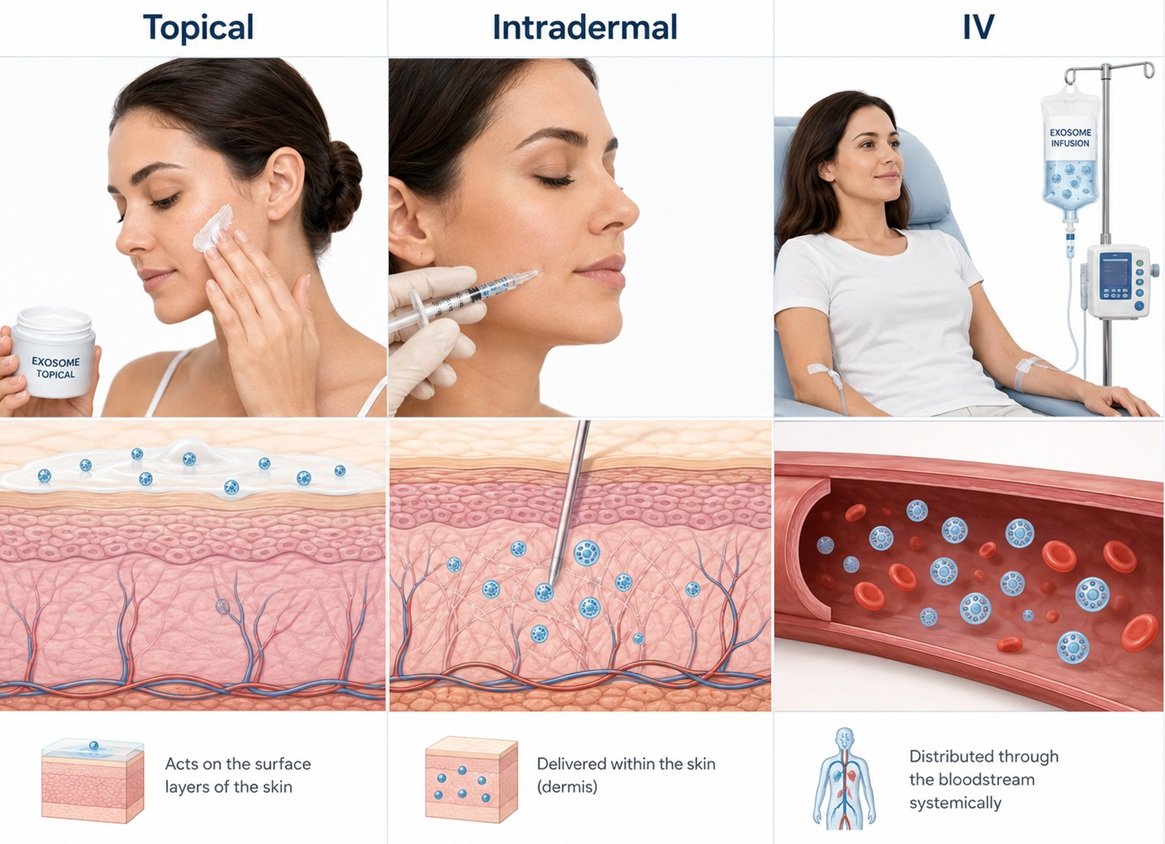
The clinic’s detailed exosome policy provides the important boundary: IV exosome treatment is not pre-booked and is not offered for general wellbeing, recovery, detox, energy or enhancement. EDEN states that IV use is considered only when the treating physician documents a medical indication and treatment plan. The page also describes topical and intradermal routes for selected local concerns. These routes must be evaluated separately because findings from local skin application cannot be used as evidence for whole-body effects from an infusion.
Before treatment, the patient should be told the exact preparation, source, concentration, route, batch and expiry, proposed indication, applicable UAE product status and why the clinician believes the likely benefit justifies the uncertainty and risks. Human research is growing, but the evidence remains specific to the product, indication and method studied. It does not establish that an exosome infusion improves collagen, immunity, inflammation, energy or biological ageing in generally healthy people. [10] [11]
Blood-Forming Stem-Cell Transplantation
Haematopoietic, or blood-forming, stem-cell transplantation is an established hospital treatment for selected cancers and blood, immune or inherited disorders. It may restore blood-forming cells after intensive therapy and requires a specialised transplant team and facility. [4]
This treatment is very different from PRP, outpatient autologous cell procedures and exosome protocols. EDEN does not offer blood-forming stem-cell transplantation. Its inclusion here helps patients recognise why the general phrase “stem-cell treatment” is too broad to describe evidence, suitability or expected recovery.
Services and Terminology at a Glance
| Approach | EDEN’s published description | Important boundary |
|---|---|---|
| Autologous PRP | Platelets and plasma prepared from the patient’s blood | Not a stem-cell treatment; indication and protocol are selected after assessment and must follow the separate DHA PRP standard |
| Autologous cell/SVF pathway | Minimally processed, adipose-derived material collected from the patient | Limited to an eligible autologous, homologous-use pathway for structural or wound support; not systemic wellness or anti-ageing treatment |
| Exosome-based treatment | Cell-derived extracellular vesicles; EDEN describes topical, intradermal and, in selected cases, IV routes | Route-specific assessment is essential; EDEN says IV is considered only with a documented medical indication, not for general wellness, detox, energy, recovery or enhancement |
| Blood-forming stem-cell transplant | Haematopoietic stem cells used in accredited transplant programmes | Specialist hospital treatment; not an EDEN service |
What Current Research Shows
Evidence in regenerative medicine is best read as a match between a particular preparation, a particular health concern and a defined outcome. A study of PRP for knee osteoarthritis does not establish that every PRP protocol works for every joint. Research on one cell source or exosome preparation does not establish the performance of all cell-based or exosome products.
This treatment-specific view is useful rather than restrictive. It helps the doctor and patient decide what information applies to the actual plan, agree on a sensible timeline and avoid judging success through an unrelated measure.
Musculoskeletal Conditions
PRP has been studied for several joint and tendon conditions, with knee osteoarthritis among the most frequently researched. A 2025 meta-analysis of randomised controlled trials reported clinically relevant improvements in pain and function at selected follow-up points for knee osteoarthritis. It also found that platelet concentration and other preparation characteristics influenced results. [6]
For a patient with a confirmed diagnosis, the goal might be easier walking, improved participation in physiotherapy or greater comfort during daily activity. The treatment plan still needs to consider the severity of the condition, alignment and stability of the joint, muscle strength, previous treatment and whether a surgical opinion is appropriate. Symptom improvement and structural change on imaging are different outcomes, so follow-up should use measures that reflect the original goal.
Cell-based treatment for knee osteoarthritis is also being studied. A 2025 systematic review and meta-analysis of eight randomised trials involving 502 patients reported improvements in pain and function after intra-articular mesenchymal stem/stromal cell treatment in unoperated knee osteoarthritis. The studies differed in cell source and dose. [9] Crucially, these results cannot be treated as evidence for every adipose-derived SVF procedure: SVF is a mixed, differently processed cell population, and a proposed EDEN pathway must be assessed on its own material, processing, indication and route.
Hair Loss
PRP is used in selected hair-restoration plans, particularly for androgenetic alopecia. A meta-analysis of randomised trials found an increase in hair density, while results for hair diameter were less consistent and protocols varied between studies. [7]
The diagnosis comes first because shedding and thinning have many possible causes. Genetics, hormonal changes, iron deficiency, medication, recent illness, stress and inflammatory scalp conditions may produce similar-looking concerns. A consultation can identify whether PRP is relevant or whether blood tests, medical treatment or a dermatology assessment should take priority.
When PRP is selected, consistent photographs, the same lighting and a planned review interval give a more reliable picture than day-to-day observation. Hair grows in cycles, so meaningful assessment usually takes place over months rather than days.
Skin Quality and Aesthetic Goals
In aesthetic medicine, PRP has been studied for concerns such as facial texture and wrinkles. A 2025 systematic review reported improvement in wrinkles and skin texture across several included studies, while also noting variation in application techniques and dosing. [8] That supports a focused conversation about the feature the patient wants to improve, the planned method and how PRP fits with skincare or other procedures.
Exosome-based approaches are being investigated for skin ageing, scarring, pigmentation, hair concerns and inflammatory skin conditions. Recent reviews describe early signals alongside substantial variation in products, protocols and study design. Many studies are small, uncontrolled or short-term, and several dermatology studies use topical or local administration after procedures such as microneedling or laser. [10] [11]
This route distinction is decisive. A short-term change after a topical or intradermal protocol does not establish a systemic benefit from an IV infusion. There is currently no sound basis in the cited human evidence for promising that IV exosomes will “teach cells to heal faster” or reliably improve collagen, immunity, inflammation, energy or ageing in a generally healthy person. EDEN’s detailed exosome page takes the same practical position by reserving any IV consideration for a documented medical indication rather than general enhancement.
Recovery and Healthy-Ageing Goals
People sometimes discover regenerative medicine while looking for better energy, faster recovery or healthy-ageing support. These are broad goals influenced by sleep, activity, nutrition, metabolic health, hormones, medication and existing medical conditions. They are not, on their own, a diagnosis or a sufficient indication for a stem-cell or IV exosome treatment.
A physician-led assessment can turn a broad concern into something specific and measurable. Depending on the history, that may mean reviewing sleep, medication, nutrition, mental health, cardiovascular risk, thyroid function, anaemia or another medical cause before discussing any elective procedure. If a regenerative option has a reasonable, indication-specific role, it can be placed within that wider plan. If not, the consultation should say so clearly.
Regenerative Medicine in Dubai
Dubai has a regulatory framework for facilities, practitioners, stem-cell services and PRP. On 20 January 2026, the Dubai Health Authority issued a circular directing healthcare professionals and facilities within its jurisdiction to review and comply with its Standards for Stem Cells Services. [2] DHA also issued a separate 2026 standard for PRP covering matters such as facility scope, practitioner training and privileging, patient assessment, consent, preparation, documentation and follow-up. [13]
Medical-product oversight is a related but separate question. The Emirates Drug Establishment is the UAE’s federal authority for regulating medical and pharmaceutical products. [14] A licensed clinic and a qualified practitioner do not, by themselves, answer whether a particular manufactured product has the appropriate status for a proposed use. That is why exosome discussions should identify the exact preparation rather than rely on the category name alone.
For patients, availability is therefore linked to more than scientific interest or use in another country. The clinical indication, source and processing of the material, product status, intended use, route, treatment setting, facility scope and practitioner’s privileges all need to align. A treatment that is investigational in a particular context should not be presented as established routine care.
EDEN summarises its current stem-cell pathway as autologous, minimally manipulated and homologous-use care for narrow structural or wound-support applications. It states that donor-derived or substantially manipulated cell products are not offered as routine outpatient care and that systemic stem-cell infusions marketed for anti-ageing, immune enhancement or detoxification are not permitted. [15] These statements concern cell therapies; they should not be used to infer the status or effectiveness of a separate exosome product.
At EDEN AESTHETICS Clinic in Business Bay, the pathway begins with a medical review. The clinic’s published information covers autologous PRP, an eligible autologous adipose-derived SVF pathway and exosome-based approaches. EDEN’s detailed exosome policy says that any IV consideration requires a documented medical indication. [16] The recommended option, if any, is confirmed only after suitability and the applicable product, practitioner, facility and regulatory requirements have been assessed.
What to Verify Before Booking
For any regenerative procedure, ask the clinic to document:
- The diagnosis or defined concern and the intended treatment outcome
- The exact material or product, its source, manufacturer or supplier and whether it is autologous or donor-derived
- How it is processed, stored and checked for identity, quality, sterility, batch and expiry
- The proposed dose and route, and whether published evidence used a comparable preparation and route
- The product’s current UAE regulatory status for the proposed use, where a manufactured product is involved
- The facility’s authorised scope and the treating practitioner’s relevant training and privileges
- Reasonable alternatives, known and uncertain risks, aftercare, follow-up and total cost
If these details are not available before consent, the patient does not yet have enough information to compare the option responsibly.
Patients travelling to Dubai can make the process more efficient by gathering relevant medical records before their appointment. Depending on the concern, useful documents may include recent blood tests, imaging, operative notes, a medication list and details of previous treatment. An initial remote discussion can help organise the visit, but a final recommendation may require an in-person examination or further tests.
Travel plans should also allow for recovery and follow-up. The appropriate time in Dubai differs between a simple same-day procedure and a pathway involving collection or additional assessment. Before booking flights, the patient should know how many visits may be needed, which activities to avoid temporarily and how care will be coordinated after returning home.
Who May Be a Suitable Candidate?
Suitability is based on the health concern, the proposed material and the patient’s overall medical picture. A potentially suitable candidate usually has a diagnosis or clearly defined concern, a treatment rationale supported by relevant evidence and a goal that can be reviewed over an appropriate period.
During assessment, the doctor may consider:
- The diagnosis, symptoms and effect on daily life
- How long the concern has been present and whether it is changing
- Previous treatments and the response to them
- Current medicines, supplements and allergies
- Relevant examination findings, imaging or laboratory results
- General health and conditions that may affect healing
- The proposed material, route and expected recovery
- The patient’s priorities and practical ability to complete aftercare

Age on its own does not answer the suitability question. Tissue condition, blood or platelet health, active illness, medication, pregnancy status, immune health and relevant cancer history can influence timing or the choice of procedure. The significance of each factor differs between PRP, a collection-based cell procedure and an exosome protocol, so the review must be treatment-specific.
For exosome-based treatment, EDEN says its assessment pays particular attention to active or previous malignancy and ongoing cancer surveillance, autoimmune disease or immunosuppression, active infection or inflammatory skin disease, hypersensitivity history, previous granulomatous reactions or problematic scarring, pregnancy or breastfeeding, and—when an injection is proposed—anticoagulants or bleeding disorders. [16] These factors do not all operate as identical absolute contraindications; depending on the patient and route, they may require deferral, avoidance, additional tests or specialist input.
Sometimes the consultation identifies a better first step. New joint pain may need imaging and a clear diagnosis. Hair loss related to a deficiency or thyroid condition needs that cause addressed. An active skin condition may require dermatological treatment before an elective regenerative procedure. Identifying that priority gives the patient a more useful route forward.
Patient selection also shapes expectations. A procedure intended to improve symptoms or support function should not be assumed to reverse advanced structural disease. A skin or hair protocol is assessed through changes relevant to that concern, not through general claims about whole-body rejuvenation. Defining success before treatment makes follow-up clearer for both doctor and patient.
Consultation, Treatment and Safety
Your First Consultation
The appointment begins with the problem the patient wants to address. Dr. Ehsan reviews the medical history, previous care, medicines and available records, then performs or arranges the examination and tests relevant to the concern. If a regenerative option fits, the discussion moves to the proposed material, treatment method, alternatives, expected timeline and cost.
Useful questions to answer before proceeding include:
- What exactly will be used, and is it collected from me or produced from another source?
- If it is a manufactured product, what are its source, supplier, batch, expiry, quality documents and current UAE status for this proposed use?
- How will it be prepared and administered, and did the relevant studies use a comparable product and route?
- Why is this option being considered for my diagnosis or goal, and what are the reasonable alternatives?
- What outcome is realistic, what remains uncertain, and when will progress be assessed?
- What short- and long-term risks are known, what is still unknown, and who should I contact if I develop a problem?
- What preparation, aftercare and follow-up will I need, and what is the full expected cost?
Patients should receive a written plan or consent information that reflects the actual procedure. This is especially valuable in regenerative medicine because broad treatment names can hide meaningful differences in products and technique.
On the Treatment Day
The experience depends on the chosen pathway. PRP commonly involves a blood draw, centrifugation and targeted injection or application during the same encounter. An autologous adipose-derived SVF procedure involves a collection step, processing within the permitted pathway and a different recovery schedule. Exosome treatment varies by product and route; topical, intradermal and IV administration should not be described as the same procedure. The team explains the sequence, estimated appointment time and preparation instructions in advance.
Comfort measures and anaesthesia, when relevant, are chosen for the procedure and treatment area. Patients should tell the team about any change in their health or medication before treatment, even if it happened after the initial consultation.
Aftercare and Follow-Up
Aftercare may include treatment-area care, temporary changes to activity, hydration guidance, medication instructions and a scheduled review. A musculoskeletal plan may continue with physiotherapy or progressive strengthening. Hair and skin protocols may use standardised photographs. Other pathways may require clinical examination or laboratory follow-up.
Some effects are assessed gradually because biological responses and tissue cycles take time. The review schedule should match the goal rather than promise an immediate result. It also gives the doctor an opportunity to adjust supporting care and decide whether any additional session is appropriate.
A Clear, Proportionate View of Safety
Each procedure has its own safety profile. With PRP, temporary soreness, swelling or bruising can occur around the blood-draw or treatment site. Any injection or collection procedure also involves considerations such as bleeding and infection. Because PRP is autologous, donor compatibility is not part of the process, although the patient’s health, platelet status, medication and treatment technique still matter.
An autologous adipose-derived SVF pathway includes considerations related to tissue collection, local or general anaesthesia where applicable, bleeding, infection, collection-site effects, processing and administration. Autologous does not mean risk-free.
Exosome-based treatment requires attention to source, identity, manufacturing quality, purity, sterility, storage, dose and route. Reported short-term effects after local dermatology protocols include redness, swelling and tenderness, while reviews have also documented uncommon but potentially serious inflammatory, allergic, granulomatous and tissue-injury events with poorly characterised or injected products. [11] Intravenous administration additionally carries cannula- and infusion-related risks and greater uncertainty about systemic effects. Long-term safety data remain limited, and absence of a problem in a small study does not establish safety for every product or route.
Before treatment, the patient receives an explanation of expected short-term effects, relevant risks, alternatives and the symptoms that should prompt a call to the clinic. The International Society for Stem Cell Research recommends treatment-specific consent in language the patient can understand. [3] Following the individual preparation and aftercare instructions helps make the process predictable and keeps communication open throughout recovery.
Dr. Ehsan’s Treatment Philosophy
“For me, regenerative medicine is not about choosing the newest product. It is about choosing the right approach for the right patient. I look at the diagnosis, medical history, previous treatments and the outcome the patient wants to achieve. When those details align, regenerative medicine can become a meaningful part of a carefully planned treatment.”
Dr. Ehsan Sotoudeh
EDEN’s current clinic profile describes Dr. Ehsan Sotoudeh as a general and minimally invasive surgeon with more than 24 years of surgical and aesthetic experience. He is a Diplomate of the American Board of Regenerative Medicine and appears in the board’s diplomate directory as Ehsan Sotoudeh, MD, DABRM. [12] He leads regenerative-medicine consultations at EDEN AESTHETICS Clinic in Business Bay.
His approach connects the procedure to the diagnosis and to the patient’s wider care. Surgical experience is useful here: a symptom can have several causes, and the decision to use an injection or collection-based procedure should follow an appropriate assessment. Where physiotherapy, medical treatment, skincare, nutrition or another specialist is relevant, it can remain part of the plan.
This physician-led model gives patients:
- A medical assessment before the treatment is selected
- A clear explanation of the proposed material and method
- A plan built around a defined concern and personal priorities
- Coordination with conventional treatment when useful
- Procedure-specific preparation, aftercare and follow-up
- A practical way to review progress over time
The result is a consultation that focuses on relevance. Innovation still matters, but it is considered alongside diagnosis, evidence, regulation and the patient’s own goals.
Frequently Asked Questions
Is regenerative medicine the same as stem-cell therapy?
No. Stem-cell and other cell-based therapies sit within the wider field of regenerative medicine, but PRP and exosome approaches are different. PRP is prepared from blood platelets, while exosomes are cell-derived particles rather than living stem cells. The distinction matters because preparation, evidence and regulation differ.
Which regenerative treatments are available at EDEN AESTHETICS Clinic?
EDEN’s current information describes autologous PRP, a limited autologous adipose-derived SVF pathway for eligible cases and exosome-based approaches. The exosome page distinguishes topical, intradermal and selected IV use. The precise option and its availability are confirmed only after clinical assessment and review of the product, route, facility, practitioner and current regulatory requirements. Blood-forming stem-cell transplantation is not an EDEN service.
Does EDEN offer IV exosomes for energy, detox or anti-ageing?
No. EDEN’s detailed exosome policy states that IV exosomes are not offered for general wellbeing, recovery, detox, energy or enhancement. The clinic says IV is considered only when the treating physician documents a medical indication and a treatment plan. A “100 billion” dose description does not establish that an infusion will improve collagen, immunity, inflammation or ageing.
Are exosomes the same as stem cells?
No. Exosomes are cell-derived extracellular vesicles and are not living cells. Their source, manufacturing, purification, sterility, concentration, storage and route influence what is actually being proposed. Evidence for one preparation or route should not be generalised to another.
How soon might I notice a change?
The timeline depends on the concern and procedure. Temporary treatment-site effects may settle within days, while changes in joint symptoms, hair density or skin quality are generally assessed over weeks or months. Your plan should state when reviews will take place and what measures will be used.
How many sessions will I need?
There is no single schedule for all regenerative treatments. Some plans begin with one procedure and a review; others use a series supported by published protocols and the patient’s response. The number of sessions should follow the diagnosis and treatment plan rather than a standard package.
Can regenerative medicine be combined with other treatments?
Often it can. Musculoskeletal care may include rehabilitation and strength work. Hair treatment may address medical or nutritional contributors. Skin plans may combine home care with other appropriately timed procedures. Your doctor should coordinate the sequence so that recovery instructions and goals remain clear.
What does regenerative medicine cost in Dubai?
Cost varies with the procedure, product, treatment area, required tests, collection or preparation method and follow-up. PRP, an autologous cell/SVF pathway and exosome treatment do not have the same cost structure. After assessment, the clinic can provide a written quotation for the proposed plan before treatment is booked.
Can international patients start with an online consultation?
An initial remote appointment may help review records and plan the visit. A final recommendation can still depend on an examination, imaging or tests in Dubai. International patients should confirm how long to stay for treatment and follow-up before booking travel.
Book a Regenerative Medicine Consultation in Dubai
If you are considering PRP, an eligible autologous cell/SVF pathway or an exosome-based treatment, a medical consultation can help you compare the options in relation to your concern. It is also the right time to discuss the product or material, expected timeline, aftercare and total cost.
Appointments with Dr. Ehsan Sotoudeh are available at EDEN AESTHETICS Clinic in Business Bay, Dubai. Use the contact and booking page to request an assessment, or review EDEN’s current regenerative-medicine service information before booking.
The first step is a clear assessment—not a pre-selected product or package. From there, regenerative medicine can be considered for what it is: a focused option within a personalised medical plan.
Medical disclaimer: This article provides general educational information and is not a diagnosis, treatment recommendation or substitute for an individual medical consultation. Mention of a service does not mean that it is suitable, available or authorised for every patient or indication. Treatment availability, suitability, potential benefits, risks and results depend on the patient, diagnosis, exact material or product, route, procedure, treating professional’s scope and current regulatory requirements. No result is guaranteed. Seek urgent medical care for severe or rapidly worsening symptoms.
Medical References
1. National Institute of Dental and Craniofacial Research, US National Institutes of Health. Regenerative Medicine. Last reviewed January 2026.
2. Dubai Health Authority. External Circular: Standards for Stem Cells Services. Reference CIR-2026-00000014, issued 20 January 2026.
3. International Society for Stem Cell Research. Stem Cell Resources for Patients.
4. National Cancer Institute, US National Institutes of Health. Stem Cell Transplants in Cancer Treatment. Updated 5 October 2023.
5. Rahman E, et al. Systematic Review of Platelet-Rich Plasma in Medical and Surgical Specialties: Quality, Evaluation, Evidence, and Enforcement. 2024. PMID: 39124838.
6. Bensa A, et al. PRP injections for the treatment of knee osteoarthritis: a meta-analysis of randomised controlled trials. 2025. PMID: 39751394.
7. Li M, et al. Effectiveness of Platelet-Rich Plasma in the Treatment of Androgenic Alopecia: A Meta-Analysis. 2024. PMID: 37644190.
8. Rodríguez-Castro MJ, Cortés-Rodríguez AE. Efficacy of platelet-rich plasma in facial rejuvenation: a systematic review. 2025. PMID: 40118148.
9. Cao M, et al. Efficacy and safety of mesenchymal stem cells in knee osteoarthritis: a systematic review and meta-analysis of randomized controlled trials. 2025. PMID: 40055739.
10. Van Delen M, et al. A systematic review and meta-analysis of clinical trials assessing safety and efficacy of human extracellular vesicle-based therapy. 2024. PMID: 38958077.
11. Wang OJE, Bajwa BB, Rivers JK. Exosome-based therapies in dermatology: a scoping review. 2026. PMID: 41931695.
12. American Board of Regenerative Medicine. ABRM Diplomates Directory.
13. Dubai Health Authority. Standards for Platelet Rich Plasma. Code DHA/HRS/HPSD/ST-73, issued 31 December 2025; linked to External Circular CIR-2026-00000019, issued 29 January 2026.
14. Emirates Drug Establishment. Official Portal. UAE federal medical- and pharmaceutical-product regulator.
15. EDEN AESTHETICS Clinic. Stem Cell Therapy in Dubai: What DHA Regulations Actually Allow. Clinic service and policy information accessed 12 August 2026.
16. EDEN AESTHETICS Clinic. Exosome Therapy in Dubai: Evidence, Risks and Assessment. Clinic service and policy information accessed 12 August 2026.