
What often starts as a vague, unremarkable stomach ache can, within a matter of hours, turn into one of the most well-known surgical emergencies in medicine. Unlike many conditions that develop slowly over months or years, appendicitis tends to move quickly, and recognising it early can make the difference between a straightforward, minimally invasive operation and a far more complicated one.
This is exactly why understanding the symptoms, causes, and modern surgical treatment of appendicitis matters.
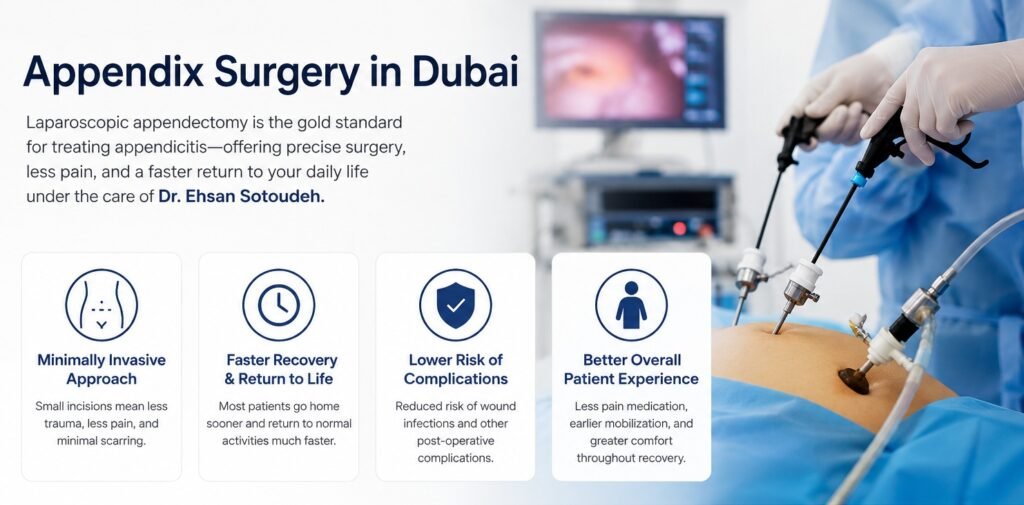
Laparoscopic appendectomy, the minimally invasive removal of the appendix, is now the standard of care for the vast majority of appendicitis cases. Under the care of Dr. Ehsan Sotoudeh, appendix surgery is approached with a strong emphasis on rapid, accurate diagnosis, surgical precision, and a fast, comfortable recovery.
The appendix is a small, finger-shaped pouch attached to the beginning of the large intestine, located in the lower right side of the abdomen. Its exact biological purpose remains a subject of ongoing scientific discussion, but what is well established is that it can become inflamed, infected, and ultimately dangerous if a blockage develops inside it.
Appendicitis occurs when the opening of the appendix becomes obstructed, most often by hardened stool, swollen lymphatic tissue, or, less commonly, a foreign body or tumour. Once blocked, bacteria trapped inside the appendix multiply rapidly, causing the organ to become inflamed, swollen, and increasingly filled with pressure. If left untreated, the appendix can rupture, spilling infected material into the abdominal cavity and causing a serious, potentially life-threatening infection known as peritonitis.
Appendicitis has a fairly recognisable symptom pattern, although it can occasionally present differently, particularly in children, older adults, and pregnant women.
A Key Clinical Insight: The pain of appendicitis classically starts around the navel because early inflammation stimulates nerves shared with that general region of the abdomen. As the inflammation progresses and begins to irritate the lining of the abdominal wall directly overlying the appendix, the pain becomes more localised and intense in the lower right side. This shift in pain location is one of the most recognisable clues clinicians rely on when diagnosing appendicitis.
Warning Sign: A sudden, temporary improvement in pain, followed by a rapid worsening accompanied by fever, a rigid abdomen, and a noticeably unwell appearance, may indicate that the appendix has ruptured. This is a surgical emergency requiring immediate medical attention, as the infection can spread quickly throughout the abdominal cavity.
Because early appendicitis pain can be vague and centred around the navel, it is often initially mistaken for indigestion, gas, or a stomach bug. This is particularly true in the first several hours, before the pain has migrated and intensified in the lower right abdomen.
This overlap with more common, less serious conditions is one of the reasons appendicitis can sometimes be missed or delayed in diagnosis. Any abdominal pain that steadily worsens over several hours, rather than easing, deserves prompt medical evaluation rather than being assumed to be a passing stomach upset.
Diagnosing appendicitis typically combines a clinical examination with imaging to confirm the condition and rule out other causes of abdominal pain.
During a physical examination, a surgeon will usually check for tenderness in the lower right abdomen, along with specific signs that suggest peritoneal irritation, such as pain that intensifies when pressure is released suddenly from the abdomen.
Ultrasound is frequently used as a first-line imaging tool, particularly in children and pregnant women, as it does not involve radiation and can often visualise an inflamed appendix directly. In adults, or in cases where ultrasound findings are inconclusive, a CT scan is often used, as it provides highly detailed imaging of the appendix and surrounding structures and is considered extremely accurate for confirming or ruling out appendicitis.
Blood tests are also commonly used to check for elevated white blood cell counts, which can support the diagnosis by indicating an active infection or inflammatory process in the body.
Unlike some surgical conditions that can be safely monitored or delayed, appendicitis is generally considered a time-sensitive diagnosis. Once the appendix becomes obstructed and infected, the risk of rupture increases the longer treatment is delayed.
A ruptured appendix can lead to:
This is why appendicitis is treated as a surgical priority rather than something to be observed over an extended period. Prompt evaluation and treatment significantly reduce the risk of these complications.
For decades, appendix removal required a single incision in the lower right abdomen. Today, laparoscopic appendectomy has become the preferred technique for the majority of cases, offering clear advantages over the traditional open approach.
In a laparoscopic appendectomy, the surgeon works through several small incisions, typically less than a centimetre each. A thin camera provides a magnified, high-definition view of the abdominal cavity, allowing the surgeon to carefully identify, isolate, and remove the inflamed appendix using specialised instruments, without the need for a large abdominal incision.
Compared with traditional open appendectomy, the laparoscopic technique typically offers:
Open appendectomy may still be recommended in certain situations, such as significant rupture with widespread infection, extensive scar tissue from previous surgeries, or specific anatomical considerations identified during the operation. The right approach is always determined based on the individual patient’s condition.
Given the time-sensitive nature of appendicitis, the process typically begins with a prompt clinical evaluation, blood tests, and imaging, usually ultrasound or CT scan, to confirm the diagnosis as quickly as possible.
Once appendicitis is confirmed, patients are prepared for surgery relatively quickly, with clear guidance provided on fasting, medication, and what to expect during and after the procedure.
Performed under general anaesthesia, laparoscopic appendectomy typically takes between 30 and 60 minutes for uncomplicated cases, though ruptured or complicated appendicitis may require additional time to thoroughly clean the abdominal cavity.
Many patients undergoing straightforward laparoscopic appendectomy are able to go home within a day of surgery. Cases involving rupture or infection may require a longer hospital stay, sometimes with a course of intravenous antibiotics.
A follow-up appointment allows the surgical sites to be checked, recovery progress reviewed, and any remaining questions addressed.
The overall goal throughout this pathway is to move from diagnosis to treatment as efficiently and safely as possible.
Recovery from laparoscopic appendectomy is generally fast for uncomplicated cases. Most patients experience mild soreness around the incision sites in the first few days, manageable with simple pain relief.
General recovery guidance typically includes:
Patients whose appendicitis had already progressed to rupture or abscess formation before surgery may require a somewhat longer recovery period, along with continued antibiotic treatment, as advised by their surgical team.
While the appendix’s exact function remains debated, its removal is not associated with any significant long-term health consequences for most patients. People live completely normal lives without an appendix, with digestion and immune function continuing as usual.
Because appendicitis can escalate quickly, waiting to see if abdominal pain improves on its own carries real risk. Pain that is worsening, migrating to the lower right abdomen, or accompanied by fever, nausea, or vomiting warrants prompt medical evaluation rather than a wait-and-see approach.
With modern laparoscopic technique, appendectomy typically leaves only a few small, barely visible scars rather than the larger incision associated with traditional open surgery.
Appendicitis does not always look the same in every patient, and certain groups deserve particular attention.
Young children may struggle to describe or localise their pain accurately, which can make appendicitis harder to recognise early. Irritability, refusal to eat, and a reluctance to move or walk normally can sometimes be the clearest signs in younger patients, even before the classic pattern of pain migration becomes obvious.
Pregnancy shifts the position of the appendix as the uterus enlarges, which means the pain of appendicitis may present higher in the abdomen than the typical lower right location, particularly in the later stages of pregnancy. Because appendicitis during pregnancy carries risks for both mother and baby if untreated, prompt evaluation is especially important, and ultrasound is often prioritised as a radiation-free imaging option.
In older patients, appendicitis symptoms can be milder or more atypical, and the condition is sometimes diagnosed later as a result. This delay can increase the risk of complications, making a low threshold for evaluation particularly important in this age group.
Can appendicitis be treated with antibiotics alone, without surgery? In select, carefully evaluated cases of mild, uncomplicated appendicitis, a course of antibiotics alone has been used as an alternative to immediate surgery. However, this approach carries a meaningful risk of the condition recurring, and surgical removal remains the more definitive, widely recommended treatment for the majority of patients.
Will I need to change my diet permanently after having my appendix removed? No. The appendix does not play an essential role in digestion, and most patients return to a completely normal diet within a short period after surgery, once initial recovery is complete.
How soon after symptoms start should I see a doctor? Because appendicitis can progress from mild discomfort to rupture within roughly 24 to 72 hours, any persistent or worsening abdominal pain, particularly if it shifts to the lower right side, should be evaluated promptly rather than monitored at home.
Appendicitis is one of the most frequent causes of emergency abdominal surgery worldwide.
Because appendicitis develops quickly and unpredictably, awareness of its symptoms is one of the most valuable pieces of medical knowledge a person can carry.
Dubai’s diverse, fast-moving population includes many residents and visitors who may be unfamiliar with local emergency healthcare pathways, or who may initially attribute early abdominal pain to travel, diet changes, or general stomach upset. Because appendicitis can progress rapidly, having quick access to accurate diagnosis and advanced laparoscopic surgical care locally is particularly important for both residents and visitors experiencing sudden abdominal pain.
Access to modern laparoscopic appendectomy in Dubai means patients can be diagnosed and treated efficiently, without unnecessary delay, using techniques that minimise pain, scarring, and recovery time.
Yes. Laparoscopic appendectomy is considered a well-established, generally low-risk procedure when performed by an experienced surgical team, particularly when appendicitis is diagnosed and treated before rupture occurs. As with any operation, some risks exist, including infection, bleeding, or, in more complicated cases, abscess formation. However, these risks are significantly lower with prompt treatment and modern surgical technique, and the vast majority of patients recover fully without long-term complications.
Appendicitis is unusual among surgical conditions in that it rarely allows for extended deliberation. Once diagnosed, the safest and most effective path forward is almost always prompt surgical treatment.
Laparoscopic appendectomy offers:
Recognising the symptoms early and seeking prompt medical attention gives patients access to the least invasive, most comfortable version of this common but serious procedure.
Dr. Ehsan Sotoudeh approaches appendix surgery with a focus on:
Patients who value speed, precision, and attentive care during a sudden medical situation often choose this approach for the treatment of appendicitis.
Appendicitis is not a condition that improves with time, home remedies, or a wait-and-see approach. Pain that is steadily worsening, especially if it has shifted to the lower right side of your abdomen and is accompanied by fever, nausea, or vomiting, needs prompt medical evaluation.
If you are experiencing these symptoms, don’t wait for the pain to become unbearable or for complications to develop. Seek an urgent medical evaluation now. Early diagnosis and treatment lead to a faster, safer, and far more comfortable recovery, and it begins with a timely conversation about your symptoms.