
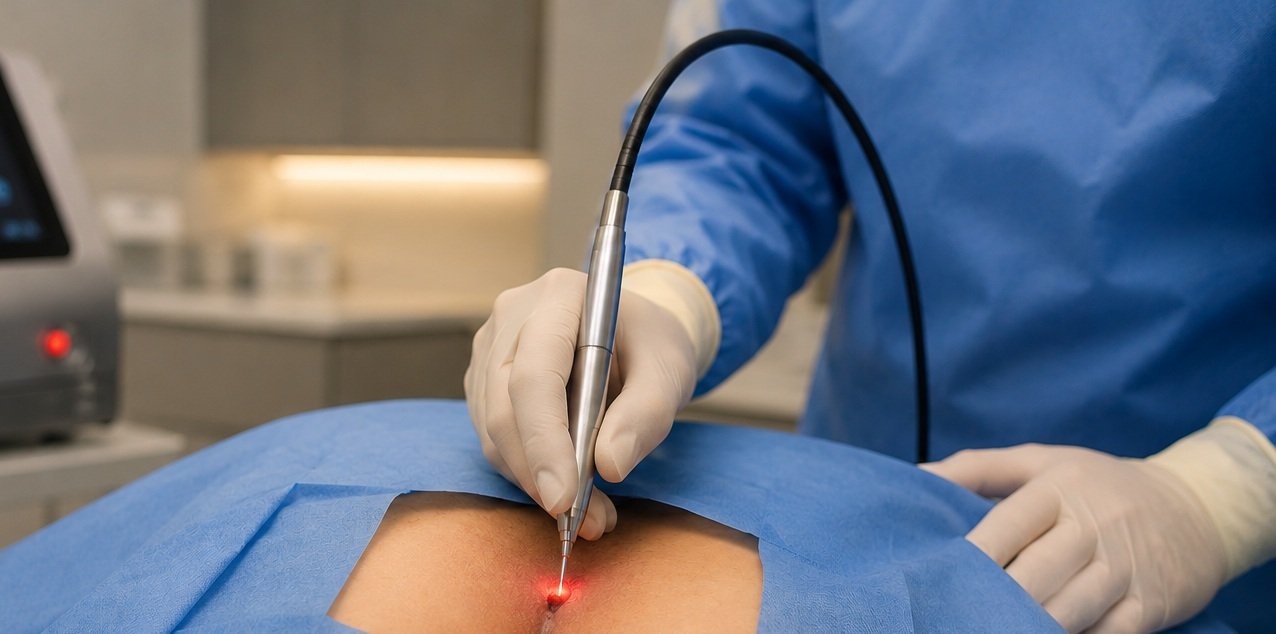
A pilonidal sinus is a small tunnel or tract that forms in the skin near the tailbone, at the top of thebuttocks cleft. While it may sound like a minor inconvenience, for many people it becomes arecurring, painful, and disruptive condition that significantly affects daily life. Traditional surgicaltreatment — though effective in many cases — often comes with a long recovery period, wound caredemands, hospital admission, and a frustratingly high rate of recurrence.
At Eden Aesthetics Clinic in Dubai, Dr. Ehsan offers a modern, minimally invasive alternative:laser-based pilonidal sinus treatment. This approach eliminates the need for open surgery, generalanaesthesia, or hospital admission. Patients are treated as outpatients, return home the same day,and resume normal activities within days — not weeks.
This article explains what pilonidal sinus is, why conventional surgery often falls short, how lasertreatment works in precise technical detail, who is a suitable candidate, and what the full treatmentjourney looks like at Eden Aesthetics Clinic.
A pilonidal sinus (also called a pilonidal cyst when infected) is an abnormal pocket or channel inthe skin, typically located in the natal cleft — the groove between the buttocks, just below thecoccyx (tailbone). The word “pilonidal” comes from the Latin for “nest of hair,” which reflects thecondition’s hallmark: loose hairs that penetrate the skin and become embedded, triggering aninflammatory reaction.
The condition most commonly affects young adults between the ages of 15 and 35, with menaffected more frequently than women. Risk factors include:
Symptoms range from a small, painless pit in the skin to a large, acutely infected abscess. Commonpresentations include:
Left untreated or inadequately treated, pilonidal sinus tends to recur, expand, and develop multipletracts — making each subsequent treatment more complex.
Conventional surgical management of pilonidal sinus has been the standard of care for decades.The most common approaches include:
The limitations of these approaches are well-documented:
For young, working adults — the demographic most commonly affected — these demands are oftenimpractical. The result is that many patients delay treatment, manage symptoms conservatively, orexperience repeated cycles of infection and drainage without definitive resolution.
Laser-based pilonidal sinus treatment — performed using techniques such as SiLaC (Sinus LaserClosure) or laser-assisted EPSiT (Endoscopic Pilonidal Sinus Treatment) — represents a significantdeparture from conventional surgery. Rather than cutting out the sinus tract, the laser destroys thetract’s inner lining from within, causing it to collapse and seal without the need for a large externalwound.
The procedure is performed under local anaesthesia, takes 30–60 minutes, and allows the patientto return home the same day.
| Feature | Laser Treatment | Traditional Surgery |
|---|---|---|
| Anaesthesia | Local only | General or spinal |
| Hospital admission | Not required (day procedure) | Often required |
| Incision size | Minimal (probe entry only) | Large excision |
| Wound care | Simple dressing changes | Daily packing for weeks |
| Return to desk work | 1–2 days | 2–6 weeks |
| Return to physical activity | 1–2 weeks | 6–12 weeks |
| Scarring | Minimal | Significant |
Laser treatment is appropriate for a wide range of patients with pilonidal sinus disease. Suitablecandidates include:
Laser treatment is generally not performed during an acute abscess phase. If active infection ispresent, the abscess must first be drained and the infection controlled with antibiotics beforedefinitive laser treatment is planned. Dr. Ehsan will assess each patient individually to determinethe most appropriate timing and technique.
Pilonidal sinus disproportionately affects young, active people — students, professionals, athletes,and parents — at a stage in life when extended time off work or restricted mobility is particularlydisruptive. The condition is not only physically uncomfortable; it carries a social dimension thatmany patients find difficult to discuss, which can lead to delayed presentation and more complexdisease by the time treatment is sought.
Laser treatment removes the practical barrier that traditional surgery creates. A patient whoundergoes laser treatment on a Thursday can, in many cases, return to a desk job by Monday.There is no open wound to manage, no daily packing, and no requirement to avoid sitting entirely.Physical activity resumes within one to two weeks rather than months.
This matters not just for convenience, but for outcomes. Patients who can return to normal lifequickly are more likely to complete follow-up appointments, adhere to post-procedure hairmanagement advice, and seek early review if symptoms recur — all of which contribute to long-term success.
Dubai’s climate and lifestyle create specific conditions that are relevant to pilonidal sinus disease.The combination of heat, humidity, and the prevalence of sedentary work environments — longhours at desks, extended commutes, frequent air travel — increases the risk of both initialpresentation and recurrence.
Sweat and friction in the natal cleft area accelerate hair penetration and skin irritation. Tightclothing, common in professional environments, compounds this. For patients who are physicallyactive — gym-goers, cyclists, runners — the condition can interfere significantly with training andcompetition.
Laser treatment’s minimal wound and rapid recovery make it particularly well-suited to Dubai’slifestyle demands. There is no large open wound that requires protection from heat or humidity, noextended period of restricted sitting, and no prolonged absence from the gym or sports.
Laser-based pilonidal sinus treatment has a well-established safety profile, supported by publishedclinical data from centres across Europe and the Middle East. Key safety considerations include:
The process begins with a thorough consultation with Dr. Ehsan. This includes a detailed review ofthe patient’s history — duration of symptoms, previous episodes of infection, any prior surgicaltreatment — followed by a careful clinical examination of the affected area. In some cases, anultrasound scan is arranged to map the extent and depth of the sinus tract before treatment isplanned.
Patients receive clear written instructions ahead of the procedure. Unlike traditional surgery, thereis no requirement for fasting. The area is shaved on the day of the procedure. Patients are advisedto wear loose, comfortable clothing and to arrange transport home, as driving immediately afterthe procedure is not recommended.
The procedure takes place in the clinic’s treatment room under local anaesthesia. The full process— from anaesthetic injection to dressing application — typically takes between 30 and 60 minutesdepending on the complexity of the tract. Patients are awake throughout and can communicatewith Dr. Ehsan during the procedure.
After the procedure, patients rest in the clinic for a short period before being discharged. Pain istypically mild and well-controlled with standard over-the-counter analgesics. A small dressing
covers the treatment site. Patients are given written aftercare instructions and a direct contactnumber for any questions.
Day 1–2: Rest at home. Mild discomfort managed with paracetamol or ibuprofen. Lightwalking is encouraged.
Follow-up appointments: Scheduled at one week, one month, and three months post-procedure to assess healing and tract closure.
Pilonidal sinus has a tendency to recur regardless of the treatment method used. The single mostimportant modifiable risk factor is hair in the natal cleft. Dr. Ehsan provides specific guidance onlong-term hair management strategies, which may include:
Combining laser sinus treatment with laser hair removal of the natal cleft offers the most durablelong-term outcome, addressing both the existing tract and the underlying cause of recurrence.
For too long, pilonidal sinus has been associated in patients’ minds with a difficult, painful, andprolonged surgical experience. That association is no longer accurate. Laser-based treatment haschanged the equation: the same condition that once required weeks of wound care and restrictedactivity can now be addressed in under an hour, in an outpatient setting, with a return to normallife within days.
The key is accurate diagnosis, appropriate patient selection, and precise execution of the lasertechnique. These are the elements that Dr. Ehsan brings to every pilonidal sinus case at EdenAesthetics Clinic.
Choosing the right practitioner for pilonidal sinus treatment matters. The outcome depends notonly on the technology used, but on the clinical judgement applied at every stage — from initialassessment to technique selection to post-procedure follow-up.
Dr. Ehsan’s approach is defined by:
Pilonidal sinus laser treatment is performed by Dr. Ehsan at Eden Aesthetics Clinic, Dubai. Theclinic provides a private, professional environment for outpatient procedures, with full clinicalsupport before, during, and after treatment. All procedures are performed to the standardsrequired by Dubai Health Authority regulations.